- HOME
- WHAT WE DO
- OUR PROCESS
- WHY USE BFLOW?
- SELF-BUILD
Spend less, Increase quality, Have more control...
In fact, we challenge you to find at least one reason why the traditional approach is better!
Let us ask: How much money are you prepared to waste on your project?
Skip full of construction waste, builders drink tea and wait for materials to be supplied on site; elevation dimensioning is wrong on plans; window sizes are different between architectural plans, actual house and what was manufactured as per the project specifications; now you need to find who is responsible for this mess and figure out how much it will eventually cost you.
Thorough analysis of a typical construction project shows that up to 30% is rework, labour is used at only 40-60% of potential efficiency, accidents account for 3-6% of total project costs, and at least 10% of materials are wasted. Projects are unsafe, inefficient, and filled with errors and possible lawsuits. Traditional contracts and practices outline responsibilities by placing too much emphasis on the consequences of failure and "it's not my fault" type of behaviour. This results in an adversarial construction culture, causing project teams not to engage in collaborative processes, much to the disadvantage of all stakeholders.
Owners are losing money on projects; on average they overpay by around 30% and cover around 40% of labour inefficiencies. And because this practice is so widespread and is just one of those "It's the way we've always done it" things, no one even asks the obvious question – is it something that could be eliminated?
Yes it could, otherwise are you happy to cover all of your project's inefficiency?
This is what Bflow can provide - another way to implement a construction project. Bflow encourages greater collaboration and trust among the project participants. We use Lean Construction - a method that increases the reliability of construction processes. It also maximizes value and minimizes waste for the owner together with cost control.
It could be an example of your project
You might think that once construction drawings and specs are approved, the design would be complete. Then you would be surprised at how much design work goes on during construction. Here are some typical observations that happen every day in construction:
Example One:
- What's that cloud in the basement drawing?
- Oh! It's an elevator shaft that hasn't been specified.
- But we are about to pour concrete! Stop everything, call the architect!
Example Two:
- How is this conference room going to be furnished?
- The electrician has to decide how to lay out the lighting and where to put the outlets.
- Someone needs to let us know where the phone and Ethernet terminations go. Call the customer!
- But we already agreed the electrician's fee to start today!
Example Three:
Owner of a plasterboard company sat down with the architect and the estimator
who were reading a table of materials and talking back and forth.
- This is just amazing!
- We have a table here that shows our plasterboard utilization on the new first-time buyer houses requires 25% more board per sq ft than that of our top-end luxury houses!
- We made the houses smaller and drove up our costs. Not exactly what we had in mind.
There is no end to onsite stories of waste of time, materials and profit such as those in the examples above. This represents both a vast, expensive problem and a great opportunity. Simply put, there is a massive disconnect between architecture and field construction, and the costs are immense. This disconnect is reflected most clearly by the inadequacy of the working drawings used to build your homes. They range from awful to just passable, with a few rare exceptions. How has this problem gone largely ignored? It's a classic example of the old conundrum, "does a fish ever know it's in water, until it's out?" Most builders have simply never seen a one set of 100% fully detailed, site-specific working drawing. Architects produce great architectural renderings and plans, and owners pay a big price for them, but when it comes to working drawings, they go cheap. And because there is no coordination and collaboration between the architect and the contractor, the owner of the project overpays for the delays and rework onsite later on.
At Bflow we use Building Information Modeling or BIM. With us your project has a live model where the 3D geometry is integrated with the quantities which is integrated with the 4D schedule which is integrated with the 5D estimate. This means that when one element of the 3D model changes, both the schedule and estimate automatically change.
Why we use BIM for design/build?
Building Information Model is the process of developing building model which is used in presenting and visualizing building components, construction sequences, resource allocation and other disciplines of construction process in a virtual environment. BIM is an object-oriented building progress tool that utilizes 4D modeling concepts to design and build a house, as well as communicate its essentials.
By using BIM objects and virtual design/construction methods to design, manage, store and update all of the files related to a construction project, we can save time significantly, improve efficiency and keep better records. The entire scope of a project (from design, scheduling and costing to contracts, purchase orders and completion) is reliably and digitally co-ordinated.
A few advantages of using BIM:
- Better informed decisions regarding specifications and costs at the design stage;
- Remove conflicts of design;
- Fewer design changes as construction gets underway;
- Less waste and fewer delays;
- Better scheduling of trades and materials;
- Improved communication throughout the process;
- Elimination of errors and hence rectifications (saving costs and resources);
- Integration to E-project server for remote access by all associated parties.
The architect, the engineer and the contractor
Sounds like the opening to a good joke, and you could be forgiven for saying that this relationship, more often than not, is such!
Successful principle contractors spend many years putting together tried and tested subcontractors and tradesmen. Every project shows the attributes or shortcomings of each operative, and the PC decides if to use that worker or firm on the next upcoming contract. Over time, these subcontractors and directly employed operatives become integral to the team that makes the principle contractor a flourishing firm. They become used to the way the PC operates, its procedures, the other members of the team, the managers. Communication improves and projects more efficient. Equally, the management team can evolve much the same way, through from site foreman, site agents, back office staff such as estimators, buyers, and of course the directors. Additionally it is critical that these two sectors of management and operatives work in harmony. This does not happen over night; indeed it takes many years of a firm's evolution and careful management to build such a well oiled machine.
When a project is successfully concluded the PC does not say goodbye to the team members and start to build a brand new team for the next project; this would be unthinkable. But for most projects, the PC does have to strike a new relationship with two new parties; the architect and the structural engineer. Often it will be a new relationship between the architect and the engineer also! This marriage of architect, engineer and contractor (AEC), is critical to a projects success.
The advantages of working from project to project with the same design team are clear and numerous, particularly in a BIM environment where all stakeholders work as a collaborative team.
So how can you; the PC have such an integral design team on board? The pivotal point, is at the stage you are initially brought together with a client that is prior to, or in receipt of planning permission for their project. On many such occasions, it is possible to show the vast positive advantages of bringing your complete AEC team to the table. All too often the client will hold this as a positive tender advantage putting you ahead of your competition!
Now who's laughing?
Simply go with the Bflow!
To feel the difference between Bflow and traditional approach here is an e-mail we received from Construction Project Manager:
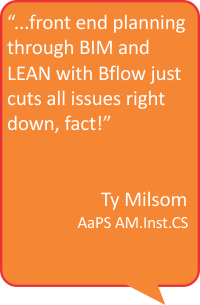
"...It's quite frustrating for me, I am working on various projects as a Contract Administrator, and/or CDM Coordinator, and the classic errors keep coming up: lack of info, lots of RFI's, lots of revisions, steels ordered incorrectly due to the contractor forced to set out columns without dims and scaling off the drawing, etc... I could go on.
Front end planning through BIM and LEAN with Bflow just cuts all this right down, fact!
I just see so many clients make the same mistake over the selection of the design team, often purely based on cost, as is the contractor, often without proper analysis of what's included and what's not. How do they miss this...well because they don't have a QS on the design team, or at the minimum, someone to hold the reigns and lead the process.
Clients just seem to think, get the cheapest and most minimum design team, hire the cheapest contractor and lets go.... Unsurprisingly, 99% of the time the project ends up costing well over the "lump sum". How can this be? PC sums, hidden in Bills, and counter charges for bad design team flaws..."
At Bflow we know how to eliminate problems that occur in traditional construction. Unnecessary steps are discarded or re-aligned, while key planning decisions are made by main stakeholders - you, the architect and the constructor. The result – your project is more predictable, costs less, gets done earlier, and has far fewer problems and better quality. You receive an increased ability to cope with uncertainty and complexity, and the ability to deliver more value as the project unfolds.
We will be more than happy to arrange a meeting with you and discuss how Bflow can deliver the full potential and maximum value for your project.

Some of our core competencies:
Architectural/Drawing services
- Building design
- 2D CAD drafting services
- Site plans
- Utility plans
- Construction phase plans
- Construction documents
- Obtaining planning permission
- Building regulations drawings
- Design/Build Programs
- 3D renderings and walk through
- 3D axonometric / perspective views
- 3D cut outs
- 3D Architectural Models
- Sun studies
- Structural works
Construction services
- Cost management
- Construction project management
- CDM health and safety co-ordination
- Health and Safety Policy
- Contract administration
- Construction legal consultancy
- Supply Chain Management
- Estimating Services
- Value Engineering
- Statutory Service Connection
- Robust Detail compliance
- Site inspections and supervision
- Project Handover/Householder Packs
- Site Waste Management Plans
- New builds and Refurbishments
Our local builders
More and more local construction companies are happy to work using the Bflow principles and philosophy.
We actively collaborate with building companies, general contractors, construction suppliers, developers, house builders, self builders, landlords, commercial and private householder clients in Gloucestershire, Worcestershire, Wiltshire, Oxfordshire and West Midlands.
Our network is constantly growing. If you would like to try Bflow method just give us a call!
24/7 Support  020 3239 3471

© 2012 Ecobase ltd
Ecobase Ltd, 145-157 St John street, London, EC1V 4PY
Bflow is a trading name of Ecobase Ltd; Registered Company Number: 6645125